

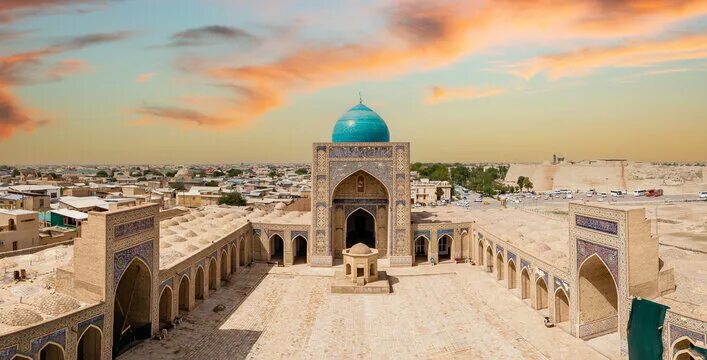
Uzbekistan is a Central Asian country with a long history shaped by trade, empire, and cultural exchange. Located along the ancient Silk Road, it served as a key link between East and West for centuries. Today, tourism in Uzbekistan focuses on historical cities, Islamic architecture, and preserved cultural traditions that reflect its role as a crossroads of civilizations.
Historical Cities and Architecture
The main attractions in Uzbekistan are its historic urban centers. Cities such as Samarkand, Bukhara, and Khiva are among the most significant destinations. These cities contain architectural ensembles dating from the medieval period, many of which are recognized as UNESCO World Heritage Sites.
In Samarkand, the Registan is one of the most prominent landmarks. It consists of three madrasahs arranged around a central square and is known for its detailed tilework and monumental scale. Bukhara offers a dense collection of mosques, minarets, and caravanserais that illustrate its historical role as a religious and commercial center.
Khiva, located in the western part of the country, is notable for its preserved inner city, Itchan Kala, which functions as an open-air museum of traditional architecture. The compact layout allows visitors to explore its walls, towers, and courtyards within a relatively small area.
Cultural Heritage and Traditions
Uzbekistan’s cultural identity reflects influences from Persian, Turkic, and Islamic traditions. Handicrafts remain an important part of daily life and tourism. Visitors often encounter ceramics, textiles, embroidery, and carpet weaving in local workshops and markets.
Traditional music and dance are also integral to cultural tourism. Performances are often organized in historic settings, providing context for the country’s artistic heritage. Seasonal festivals and public events contribute to the preservation of these traditions.
The Capital and Modern Development
The capital city, Tashkent, represents a more modern aspect of Uzbekistan. Rebuilt after a major earthquake in 1966, the city features wide avenues, public squares, and a mix of Soviet-era and contemporary architecture. Tashkent also contains museums, theaters, and educational institutions that support cultural tourism.
Infrastructure development in recent years has improved access to major destinations. High-speed rail connections link Tashkent with Samarkand and Bukhara, facilitating travel between historical regions.
Landscapes and Regional Diversity
Although tourism in Uzbekistan is primarily focused on cities, the country also offers natural landscapes. Desert areas such as the Kyzylkum Desert and mountain regions in the east provide opportunities for outdoor activities, including trekking and eco-tourism. Rural areas allow visitors to observe traditional lifestyles and agricultural practices.
Cuisine and Local Experience
Uzbek cuisine is an important part of the tourism experience. Dishes are often based on rice, meat, vegetables, and spices. The most well-known dish is plov, a rice-based meal prepared with meat, carrots, and onions. Bread, known as non, and tea are central elements of daily meals.
Markets, or bazaars, play a key role in local life. They offer fresh produce, spices, and handmade goods, serving as both commercial and social spaces for residents and visitors.
Practical Information
- Best time to visit: April to June and September to November
- Climate: Continental, with hot summers and cold winters
- Currency: Uzbekistani Som (UZS)
- Transportation: Rail, domestic flights, and road networks
Tourism in Uzbekistan is defined by its historical continuity and architectural heritage. The country’s cities provide insight into centuries of cultural exchange along the Silk Road, while local traditions and cuisine add depth to the travel experience. With improving infrastructure and growing international interest, Uzbekistan continues to develop as a destination focused on history, culture, and regional identity.